We may earn a commission when you buy through links on this page, at no extra cost to you. Tools can’t pay for placement or scores. How we make money · How we test
Every “best Etsy tools” list recommends the same six products, usually copied from each other’s affiliate tables, sometimes with prices that died years ago. We did it differently: we created fresh accounts on the free plan of every tool we could, ran the same seed keywords through each one on the same day, and wrote down what the screen actually showed. Some of what we found contradicts every list we’ve read, starting with the fact that one of these tools doesn’t exist under its listed name anymore.
In this report
The quick verdict
eRank: best for most Etsy sellers
The only tool in our test that was honest when a keyword had almost no searches, and the deepest free per-keyword analysis of the group: for every search it breaks down the top 100 ranking listings (average price, tags, categories, processing times). Paid starts at $5.99/mo, a third of what the competition asks.
Try eRank Free →Free plan · 5 keyword searches/day · No card required
In a hurry? eRank if you want honest keyword data for the least money. Alura if you want revenue estimates on a $0 budget. It’s the only tool that still shows sales and revenue numbers on the free plan. EverBee if you’re willing to pay $29.99/mo for the smoothest research workflow inside Etsy itself.
Is your tool’s search volume accurate? We tested five of them
On the same day in July, one keyword came back as under 20 searches a month in eRank and 481,900 in Alura. Competing-listing counts are the number the tools agree on. Full data, re-tested October 2026.
All six tools, one table
| Tool | Score | Best for | Free plan | Paid from | Standout finding from our test |
|---|---|---|---|---|---|
| eRank | 8.5 | Keyword research on a budget | Yes (5 searches/day) | $5.99/mo | Free top-100 listing analysis per keyword |
| EverBee | 8.3 | Paid, browse-first product research | Yes (revenue data locked) | $29.99/mo ($19.99 annual) | Famous free revenue overlay is no longer free |
| Alura | 8.2 | Free revenue estimates + all-in-one suite | Yes (5 searches/day/tool) | $11.99/mo ($7.99 annual) | Only tool showing sales & revenue estimates free |
| Marmalead (provisional) | 7.1 | SEO-focused veterans | Trial | $19/mo | Not hands-on tested: desk-research score |
| EHunt (ex-EtsyHunt) | 6.5 | Bulk keyword database | Yes (5 searches/day) | $9.99/mo | Rebranded; the old $3.99 price no longer exists |
| Sale Samurai | 5.0 | Competing-listing counts inside Etsy | Yes (20 searches/mo, no card) | $19.99/mo ($16.65 annual) | All 10 keyword volumes landed in one 3.2x band |
The one thing our testing revealed that no list tells you
We asked five tools the same question: how many people search Etsy for “personalized dog mom gift” each month?
| Tool | Monthly searches | Competition |
|---|---|---|
| eRank | < 20 | 127,999 |
| EverBee | 4,200 | 152,000 |
| Sale Samurai | 10,882 | 188,543 |
| Alura | 481,900 | 182,200 |
| EHunt | no exact-match number at all | N/A |
That’s a 24,000× disagreement on “search volume,” while all the tools roughly agree on competition. The reason is simple once you see it: competition is a real, countable number (listings matching the phrase), but “search volume” is each vendor’s private estimate, built from different sources they don’t disclose, and labeled with the same confident-looking name.
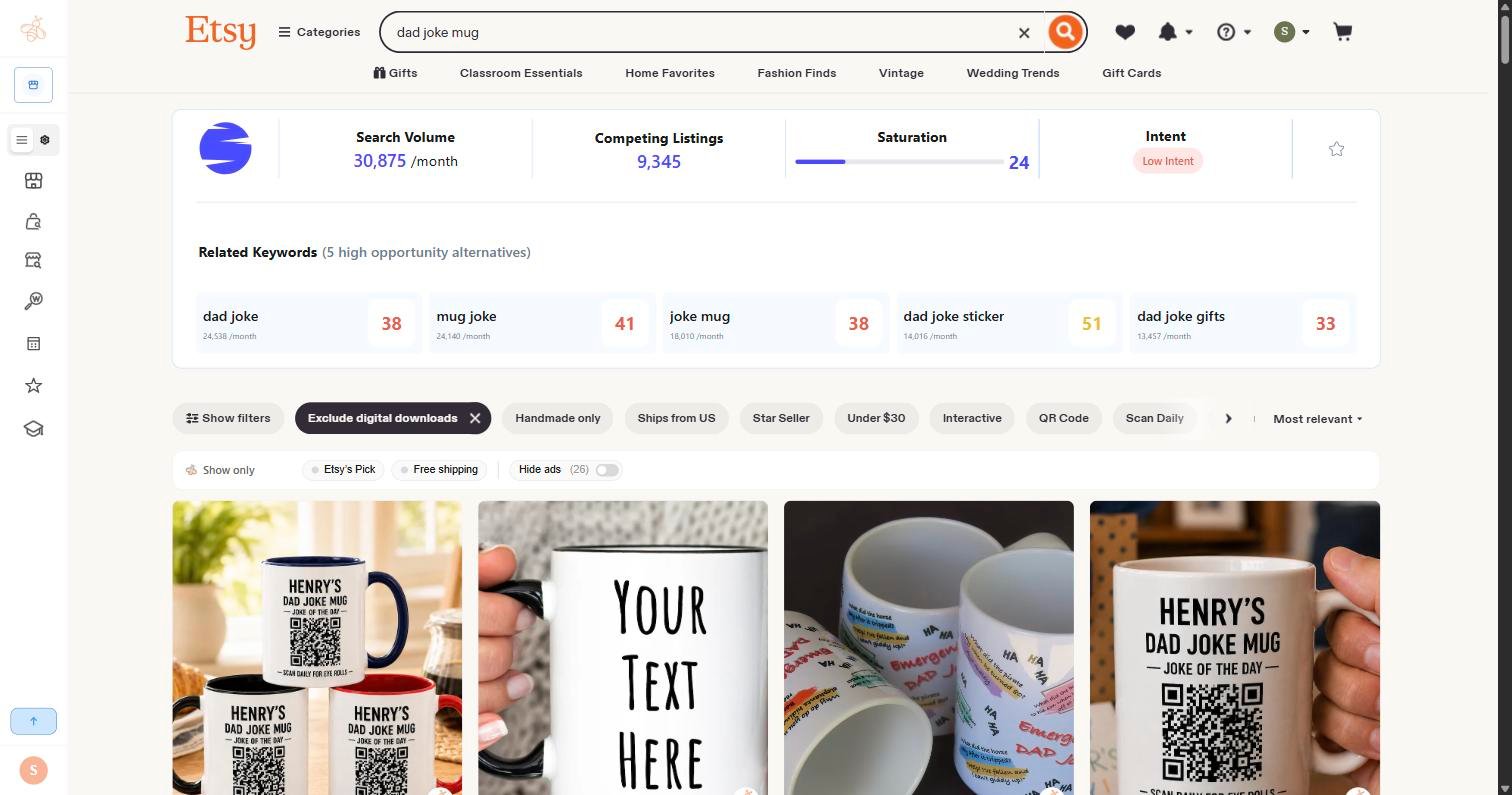
Sale Samurai’s later test drove the point home. Its competing-listing counts matched eRank’s within 1.07x to 1.71x on all nine keywords we could compare, in identical order. Its search volumes put a novelty phrase (“dad joke mug,” 30,875/mo) above a head term (“custom name necklace,” 18,799/mo). The countable number agrees across tools. The modeled one does whatever the vendor’s model says.
What this means for you: never treat an absolute volume number as real, and never compare volumes across two different tools. The usual next line, and one we used to print here, is “just compare keywords within a single tool.” We tested that advice against our own data and it only half holds. All four tools agreed on the strongest keyword, putting “custom name necklace” first or second. But “personalized dog mom gift” was ranked number one by Alura, third by EverBee, last by Sale Samurai, and unmeasurable by eRank: the same phrase at both ends of the same list. So use one tool to find your best candidate, and do not trust any of them to rank the weak ones against each other.
We pulled every figure from this testing into a standalone study with the full dataset, the ranking test, and the reasons the numbers behave this way: We asked five Etsy keyword tools the same question and they disagreed by 24,000x. It is free to cite.
1. eRank: best for most sellers
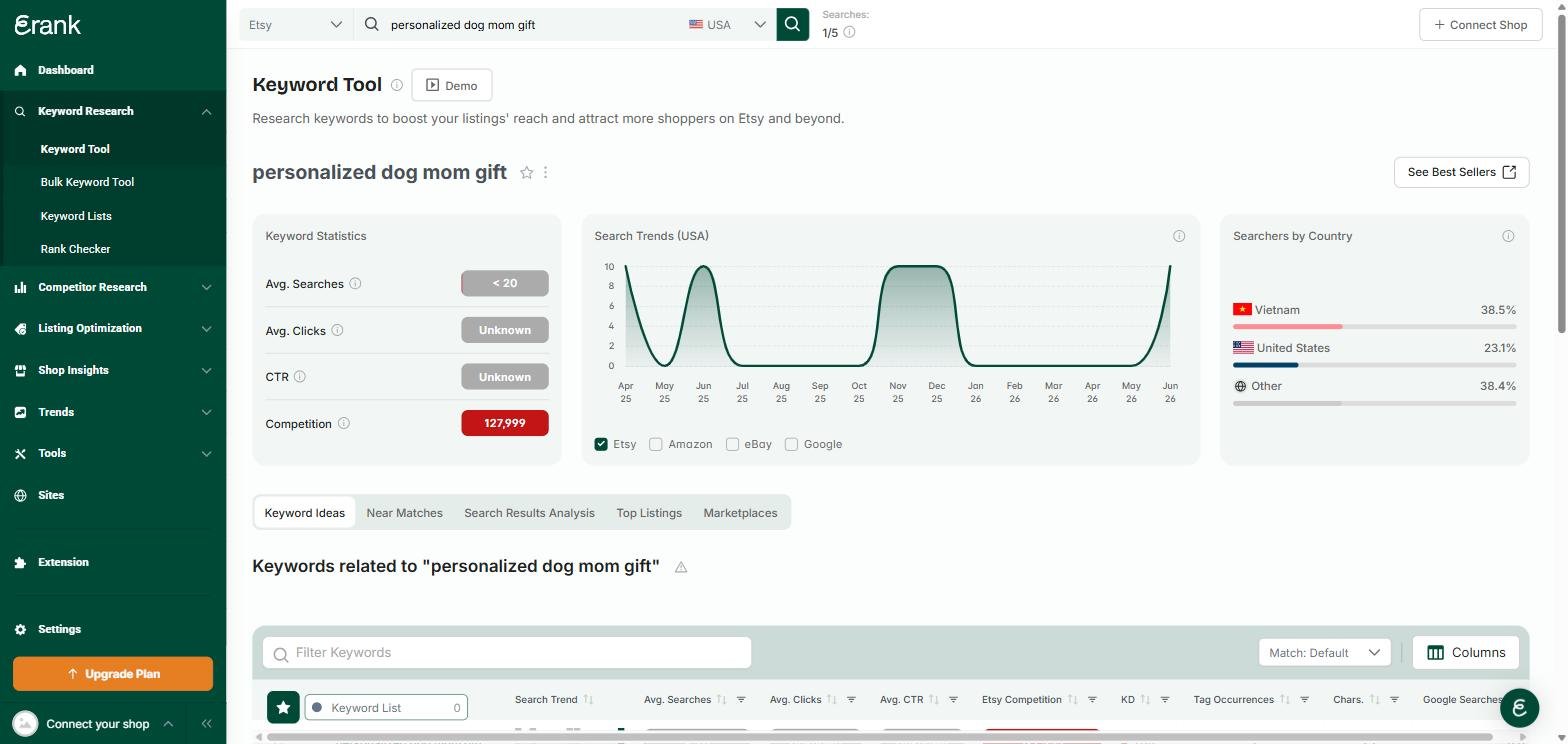
eRank won our test by being the tool that told us the truth. When a keyword every other tool inflated had almost no real searches, eRank said so: “<20.” When we searched “custom name necklace,” it produced believable, consistent numbers (2,523 searches, 2,762 clicks, competition 87,377). And its free per-keyword analysis is the deepest we’ve seen anywhere: for each search it dissects the top 100 ranking listings, average price ($25.49 for our dog-mom keyword), median price, total views, a tag word-cloud, category percentages, even processing times.
Two details from our testing you won’t find elsewhere. First, eRank shows who searches a keyword: for “personalized dog mom gift,” 38.5% of searchers were in Vietnam versus 23.1% in the US, a strong hint that print-on-demand sellers researching the term outnumber actual buyers. Second, the honest limits: the free plan is 5 keyword searches per day with a visible counter, and the related-keyword ideas table is paywalled. Deep analysis free, broad discovery paid.
- Data believability9/10
- Keyword research depth9/10
- Product research7.5/10
- Ease of use7/10
- Free tier8/10
- Value for money9.5/10
What works
- Honest low-volume reporting: the only tool that admits when a keyword is dead
- Free top-100 listing analysis per keyword (prices, tags, categories, processing times)
- Searchers-by-country reveals seller-research traffic vs. real buyers
- $5.99/mo Basic (100 lookups/day) is the best value in the category
What doesn’t
- 5 free searches/day goes fast; related-keyword ideas are paid
- Dated interface next to Alura and EverBee
- A “109% click-through rate” took us a minute to decode (multiple clicks per search). Stats need better labeling
Try eRank Free →Free plan · Basic $5.99/mo · Pro $9.99/mo
Go deeper: we ran eRank and EverBee head to head on the same keywords, across five rounds.
Full review: eRank Review 2026: we tested 10 keywords over two days, including the country panel that reveals which searches come from other sellers.
2. EverBee: smoothest workflow, if you pay
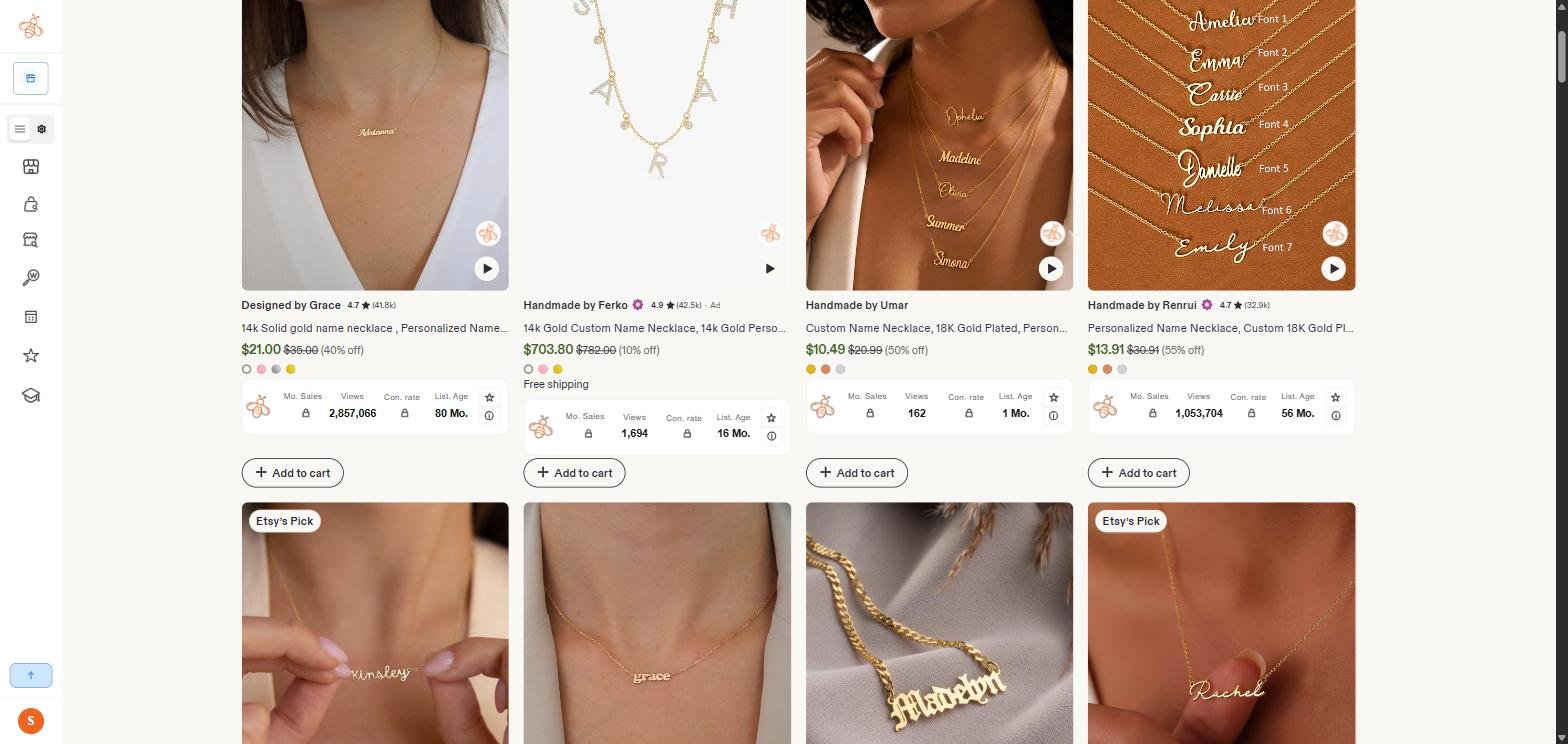
Here’s what every other review still tells you: install EverBee’s free Chrome extension and see revenue estimates on every Etsy listing. Here’s what our fresh account showed on July 16, 2026: Monthly Sales, Total Sales, Revenue and Conversion Rate are all padlocked on the free plan, extension included. The overlay that made EverBee famous now costs $29.99/mo (or $19.99/mo billed annually). What’s still free: views, listing age, favorites, a shop’s lifetime sales count, and a genuinely excellent profit calculator whose math we verified against Etsy’s published fees to the cent (6.5% transaction fee, 3% + $0.25 processing, $0.20 listing fee).
Paid, EverBee remains the smoothest research workflow of the six: search Etsy normally, see the money, click through to tag analytics. The extension even adds small quality-of-life features to Etsy search, like an “exclude digital downloads” filter and an ad-hiding toggle. But the free plan is now a demo, capped at 10 keyword searches, and its “related keywords” list padded with word-order permutations of your query, each showing nearly identical volumes: machine-generated filler, not research.
- Data believability7/10
- Keyword research depth7/10
- Product research9/10 (paid) · 5/10 (free)
- Ease of use9.5/10
- Free tier5/10
- Value for money7/10
What works
- Best-in-class workflow: research happens inside Etsy, zero context switching
- Profit calculator is accurate to the cent (we checked the fee math)
- Bulk keyword analysis: paste a comma-separated list, get all cards at once
- Shop Analyzer shows lifetime sales counts free
What doesn’t
- The famous “free revenue overlay” is gone. All revenue metrics are paid now
- Free keyword research capped at 10 searches
- Related-keyword suggestions are word-order permutations with cloned volumes
- Extension demands a separate login and its popup rejected our (correct) password. Use the full sign-in page it opens instead
Try EverBee Free →Free plan (no revenue data) · Growth $29.99/mo or $19.99/mo annual
Full review: EverBee Review 2026: what is still free on the Hobby plan, including the profit calculator math we checked against Etsy’s published fees.
3. Alura: the free-tier surprise
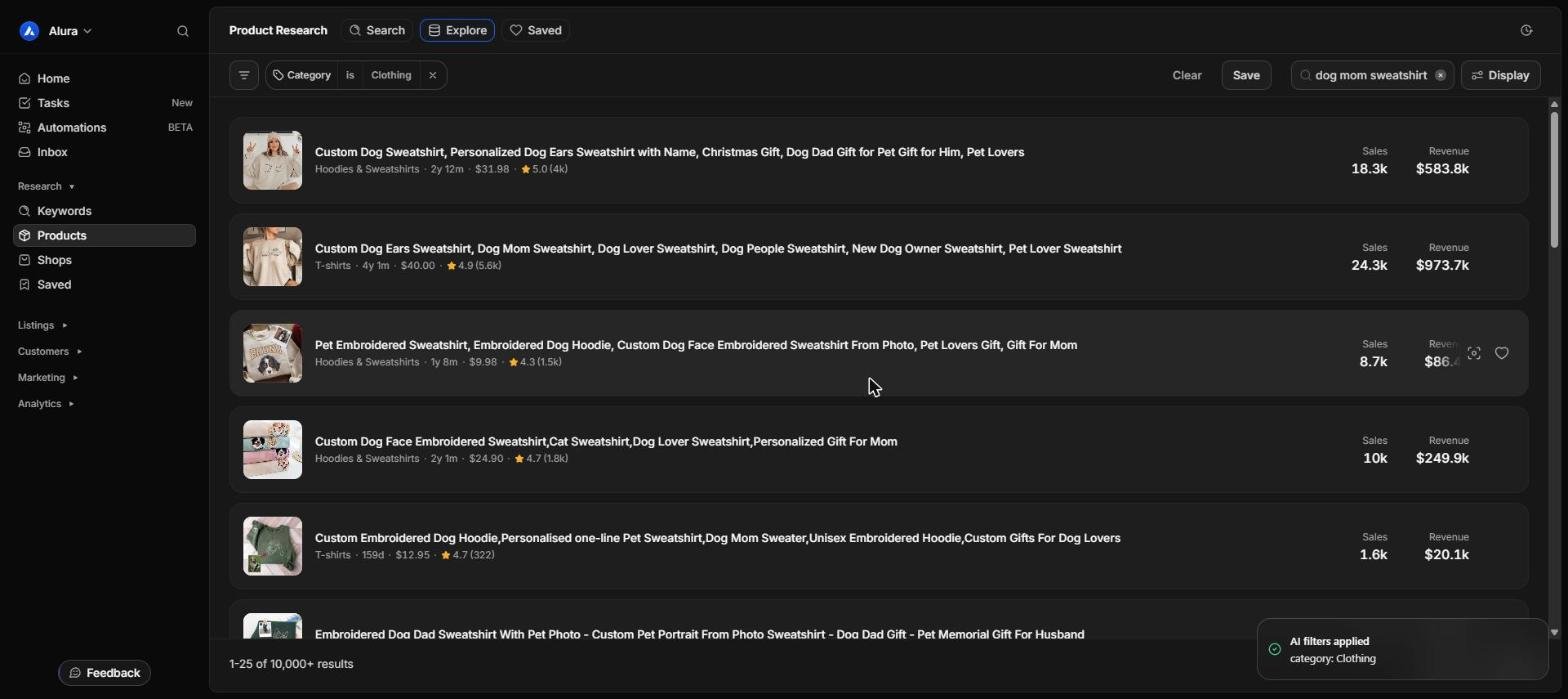
Alura quietly rebuilt its entire platform in 2026 (new app, workspaces, automations, an AI assistant), which means most reviews you’ll read describe a product that no longer exists. Our test found the new platform’s headline feature by accident: product research with sales and revenue estimates, free. The exact numbers EverBee now locks behind $29.99/mo, Alura shows on its $0 plan (5 searches per day per tool). Search “dog mom sweatshirt” and you get 10,000+ listings with estimated sales and revenue, auto-filtered by an AI that correctly guessed we wanted finished clothing products.
The honesty cut: Alura’s keyword search volumes were the most inflated in our test (481,900 monthly searches for a phrase eRank measured at under 20). The numbers look Google-scale, not Etsy-scale, and nothing in the interface says which. And the beta shows its seams: trend charts rendered on one of our five keyword queries, and product thumbnails displayed as black boxes. Treat its relative rankings as useful and its absolute numbers as decoration.
- Data believability6/10
- Keyword research depth8/10
- Product research8.5/10
- Ease of use9/10
- Free tier9/10
- Value for money8.5/10
What works
- Sales and revenue estimates on the free plan, unique in this group now
- 52 related keywords with full data, free (EverBee pads, eRank paywalls)
- Most modern interface of the six; AI filters genuinely save clicks
- Growth at $14.99/mo annual undercuts EverBee with more bundled (Pinterest tools, follow-up emails)
What doesn’t
- Search volumes are wildly inflated and unlabeled: worst absolute numbers we saw
- Beta jank: empty trend charts, black-box thumbnails
- Related keywords show the same permutation-cloning as EverBee
Try Alura Free →Free plan · Basic $11.99/mo · Growth $29.99/mo ($14.99 annual)
Full review: Alura Review 2026: hands-on with the rebuilt beta, and why its search volumes need handling with care.
4. Marmalead: the SEO coach (not hands-on tested)
Transparency note: Marmalead is the one tool here we still have not run our rubric on, so its score stays desk research and stays labeled provisional. It is card-gated, and our rule is that we do not spend money on tools. Marmalead grades listings like a teacher: letter grades, plain-English coaching, seasonal trends. Long-time sellers swear by it; at $19/mo with no meaningful free tier, it has to beat eRank’s $5.99 Basic plan to justify itself for newcomers.
5. EHunt: formerly EtsyHunt, and the price went up
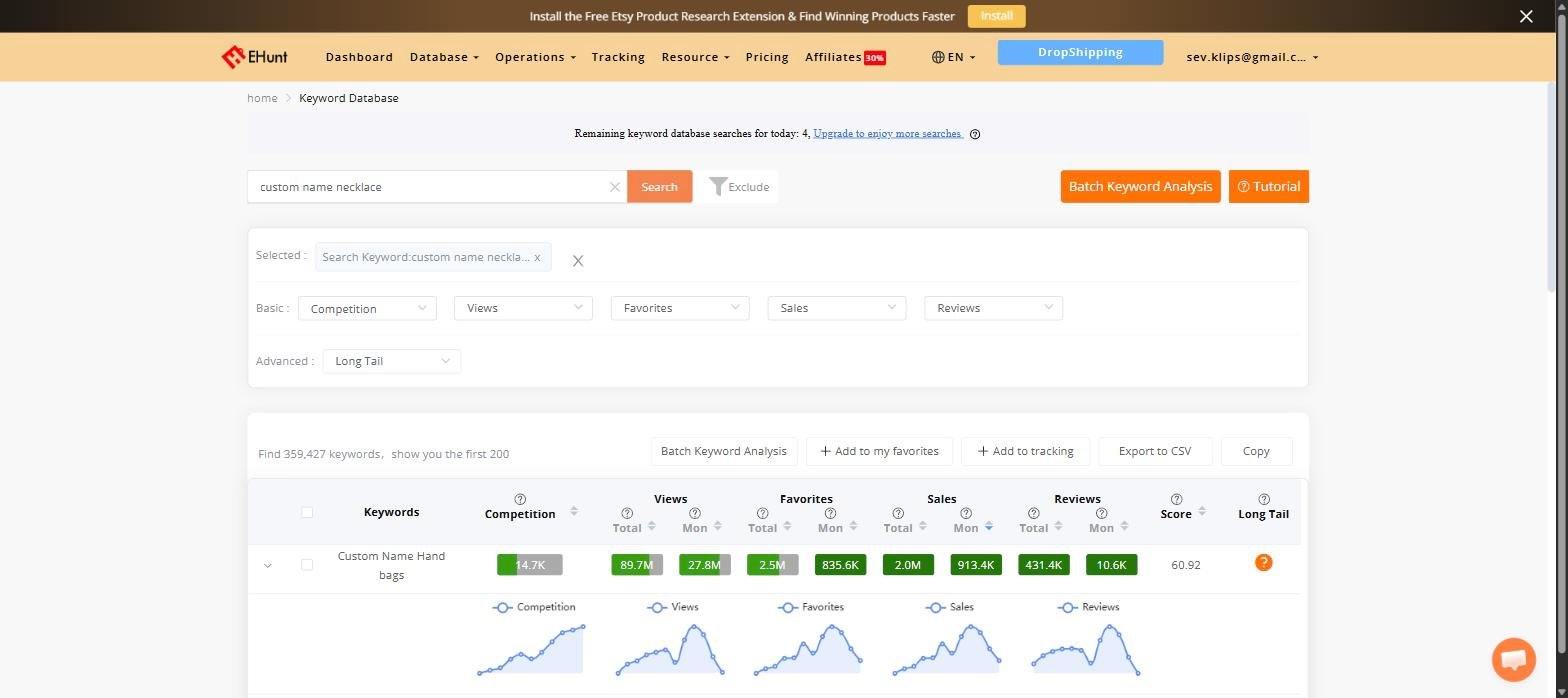
First, the correction every other list still gets wrong: EtsyHunt is now EHunt (ehunt.ai), and the $3.99/mo price those lists quote doesn’t exist. Paid plans now start at $9.99/mo ($7.99 annual), with the platform pushing sideways into TikTok Shop analytics and dropshipping tools.
Our test explains the last-place score. EHunt’s keyword tool doesn’t answer the question you asked: search “custom name necklace” and instead of stats for that phrase, you get a database dump of 359,427 “related” keywords, topped, in our test, by “Custom Name Hand bags.” The numbers attached are implausible aggregates (30 million views for “Bichon dog mom gift”), the relevance ranking is loose, and the score column wanders across scales (60.92 here, 257.49 there) with no explanation. There’s real breadth in the 19-million-keyword database and the free tier (5 searches/day) matches eRank’s, but breadth without believability is noise. Add countdown-timer flash sales on the pricing page and auto-renew warnings in the header, and the rough edges win.
- Data believability4/10
- Keyword research depth6/10
- Product research6.5/10
- Ease of use5.5/10
- Free tier7/10
- Value for money6/10
What works
- Huge keyword database (19.1M) with CSV export on the free plan
- 5 free keyword + 5 free product searches daily
- Fee calculator, niche finder and competitor tracking bundled in
What doesn’t
- Can’t produce exact-match stats for the keyword you searched
- Implausible aggregate numbers with no methodology, erratic scoring scale
- Busy, promo-heavy UI with countdown-timer sales pressure
- The bargain price that justified the rough edges is gone
Try EHunt Free →Free plan · Basic $9.99/mo ($7.99 annual)
Full review: EHunt Review 2026: what happened to EtsyHunt and its $3.99 plan, with the proof of the price change in the vendor’s own pricing page.
6. Sale Samurai: precise numbers we could not believe
Correction, July 30, 2026: this section previously said Sale Samurai had no free tier and gated its trial behind a card, and quoted $9.99/mo. Both were wrong. It has a permanent Freemium plan that takes no payment method, and paid pricing is $19.99/mo or $16.65/mo billed annually. We then tested it properly, and its provisional 7.6 became a tested 5.0.
Sale Samurai sells one thing above all: real Etsy search volume rather than estimates. So that is what we tested, ten keywords through its Chrome extension on a free account. Every volume came back between 10,398 and 32,922 searches a month. Real demand is power-law distributed and our keyword set was chosen to span it, so a 3.2x band across all ten is not a result, it is a symptom. Saturation returned its maximum value of 100 on nine of the ten. Intent never once returned “High.”
The related-keyword panel then contradicts itself. “name custom necklace” reported exactly 18,799 searches, byte-identical to our “custom name necklace” search, while “necklace custom name” reported 13,737 and “pdf crochet pattern” reported 3.2x more than “crochet pattern pdf.” Word order either matters or it does not. Here it does both.
Credit where it is due: its competing-listing counts matched eRank’s within 1.07x to 1.71x on every keyword we could compare, in identical order, and the free tier really does take no card. The countable number is fine. The modeled one is what you are paying $19.99/mo for.
See Sale Samurai →Freemium $0 · No card required · $19.99/mo ($16.65 annual)
Full review: Sale Samurai Review 2026: we tested 10 keywords and every one came back 10k+, with the full data table and the permutation results.
FAQ
Do I actually need a product research tool for Etsy?
You can start without one. Etsy’s own search suggestions are free research. A paid tool earns its fee the moment you’re choosing between product ideas and need to know which niche actually has demand. That decision is exactly what these tools de-risk.
What’s the best free option?
Right now: Alura’s free plan (the only one still showing sales and revenue estimates) plus eRank’s free plan (the deepest per-keyword analysis). Together they cover more than EverBee’s free plan does since its revenue data moved behind the paywall.
Are the search volume and revenue numbers accurate?
Treat every absolute number as an estimate, and don’t compare numbers across tools. In our side-by-side test, the same keyword showed under 20 monthly searches in eRank, 4,200 in EverBee, 10,882 in Sale Samurai and 481,900 in Alura. Most of the tools at least agree on relative rankings (which keyword is stronger than which), and that’s the level at which they’re useful. Sale Samurai is the exception: its ten volumes all landed inside one 3.2x band, so even the relative reading breaks down. Anyone quoting these numbers as facts hasn’t run the comparison.
Should I pay for more than one?
Most sellers shouldn’t. Start free with Alura + eRank. If you outgrow them, pick the one paid tool that fits your workflow: eRank Basic ($5.99) for keyword-first research, EverBee Growth ($19.99 annual) if browse-first research inside Etsy is worth the premium to you.