We may earn a commission when you buy through links on this page, at no extra cost to you. Tools can’t pay for placement or scores. How we make money · How we test
Sale Samurai sells one promise above all others: real Etsy search volume, not estimates. It is the reason people pick it over the cheaper tools, and it is the claim we went in to test. Ten keywords later we have a problem with it. Not because the numbers are too high, though they are, but because of what they refuse to do. Real search demand is wildly uneven. Sale Samurai’s numbers are not. Every single keyword we ran, from a niche joke mug to a head term half of Etsy competes for, came back inside the same narrow band.
In this review
The quick verdict
Sale Samurai: the extension is pleasant, the search volumes did not survive ten keywords of testing
The Chrome extension puts a clean data strip on top of Etsy search and the free tier genuinely needs no card. But across ten keywords with wildly different real-world demand, every volume landed between 10,398 and 32,922 a month, saturation returned its maximum value on nine of ten, and reordering the words in a phrase produced volumes that were sometimes byte-identical and sometimes three times apart. The one number we could independently sanity check, the competing listing count, was solid. The modeled numbers were not. This is the lowest score we have given.
See Sale Samurai →Freemium $0 · 20 keyword searches/mo · No card required
In a hurry? If you want keyword numbers you can act on, eRank is the pick at $5.99/mo and it was honest enough to report “under 20” on keywords Sale Samurai rated at 30,875. If you want free revenue estimates, Alura still gives those away. Sale Samurai’s free tier is worth 20 minutes of your curiosity, and its competing-listing counts are usable. Its search volumes are not something we would build a product decision on.
What the free plan gives you, and the wall behind it
Sale Samurai’s Freemium tier is real and it is not card-gated. We signed up, gave no payment method, and the account confirmed it: under Payment Details, “No payment methods are available.” That is worth saying plainly, because our own roundup got this wrong before we tested and said the trial was card-gated. It is not.
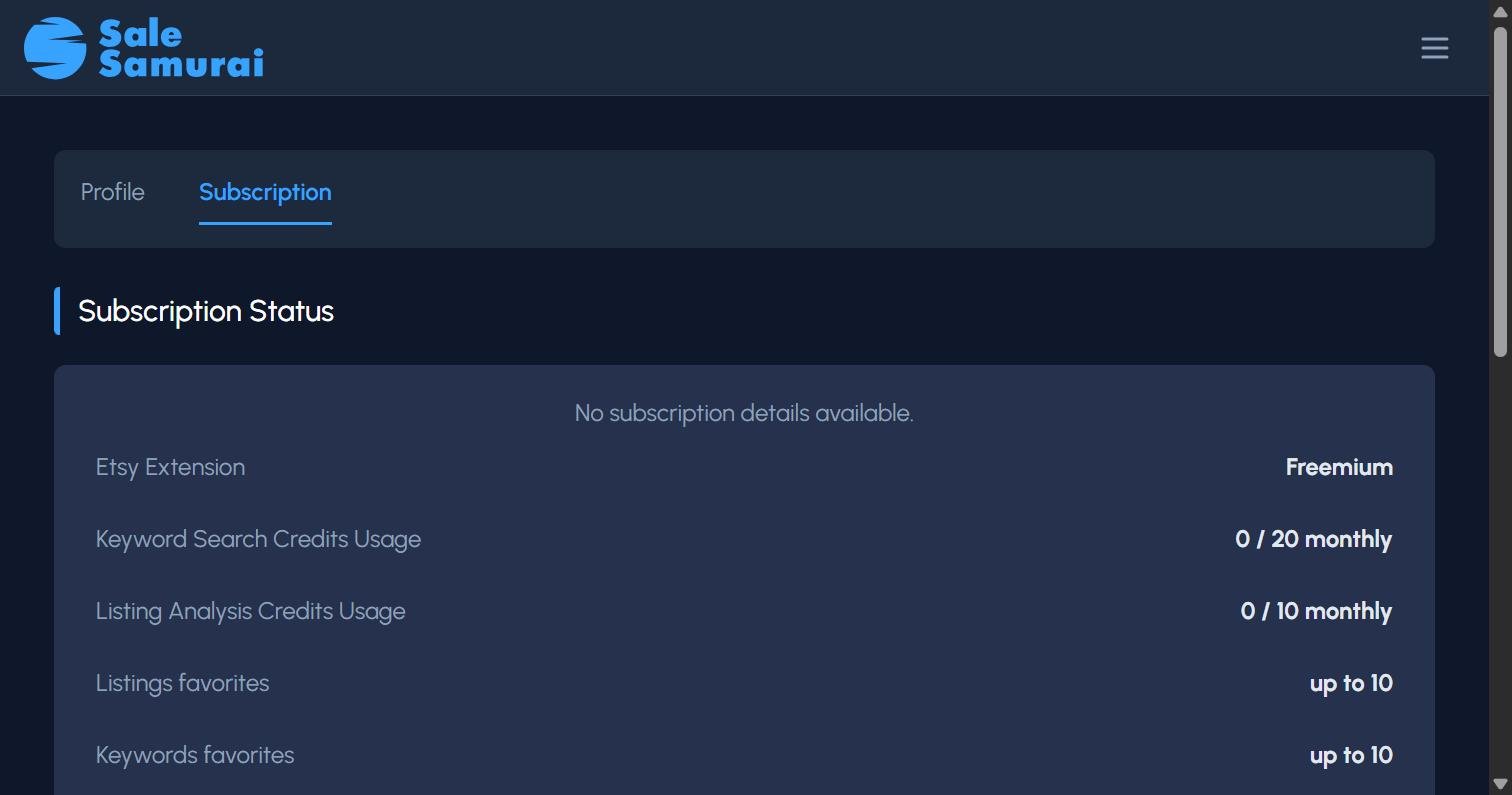
Here is what Freemium includes:
| Feature | Freemium |
|---|---|
| Keyword searches | 20 per month |
| Listing analyses | 10 per month |
| Saved keywords / listings | 10 each |
| Payment method required | No |
| Web app Search tool | Blocked |
| Shops, Calculator, Competition Tracker | Blocked |
That bottom half is the part the pricing page does not tell you. Every research tool inside the Sale Samurai web app is paywalled on Freemium, and the app never says so. Click “Search” in the nav and it highlights, then silently drops you on the subscription page. No modal, no “upgrade to unlock,” no explanation at all. We checked whether it was a navigation bug by typing the URL directly. Same result, so it is a route guard.
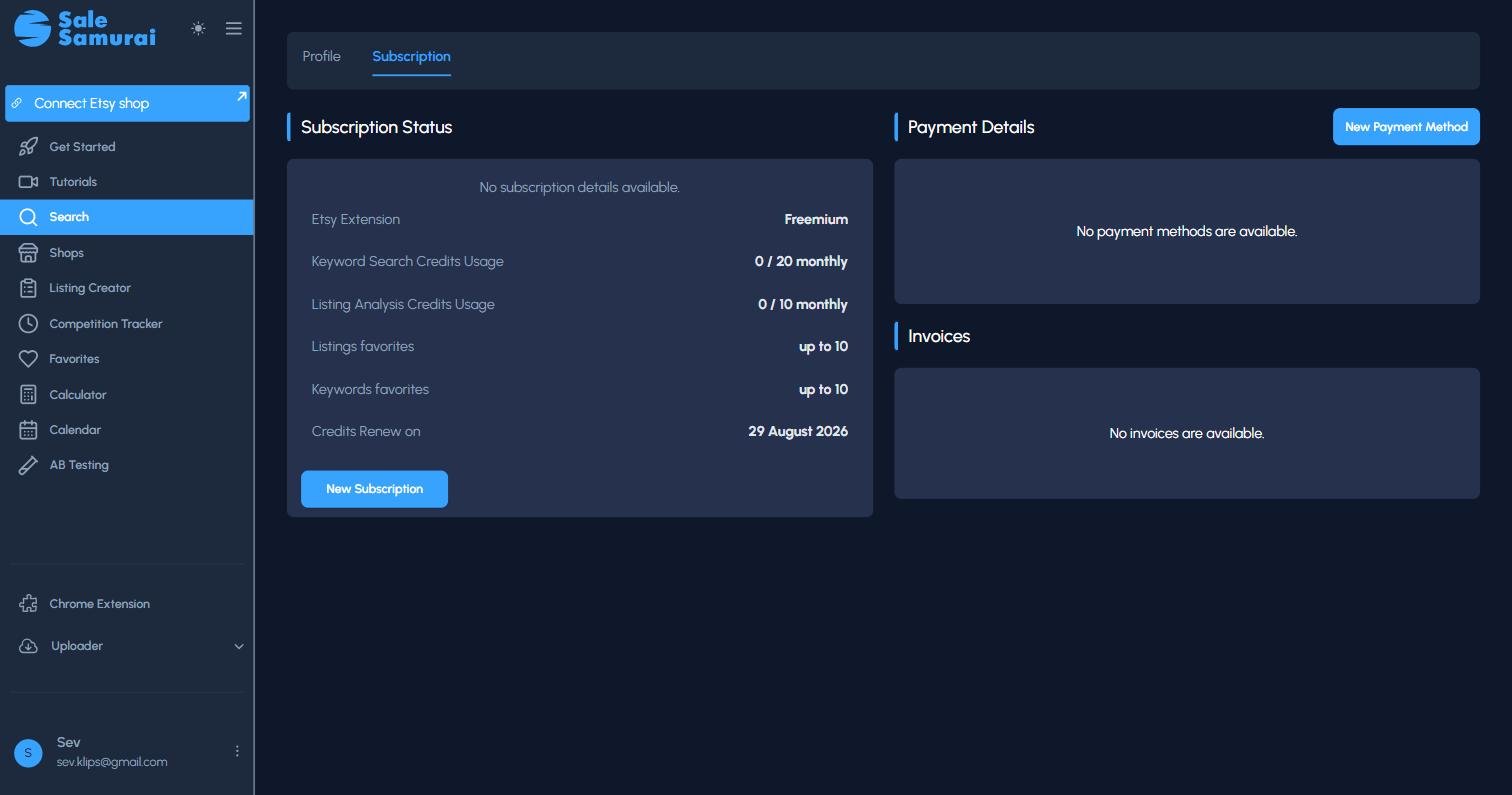
So your 20 free credits are spendable in exactly one place: the Chrome extension, while you browse Etsy. That is a defensible product decision. Silently redirecting people who click a tool they cannot use is not. “Keyword Research: 20 searches / month” on the pricing page reads as though the Search tool is included, and it is not.
The extension itself is the good part. Run any Etsy search with it installed and a strip appears above the results: search volume, competing listings, saturation, intent, and five related keywords with their own volumes. It is fast, it does not fight the page, and it costs one credit per keyword. We started at 0 of 20 and finished at exactly 10 of 20 after ten keywords, so the credit accounting is honest. Credits renew monthly.
Pricing: verified on salesamurai.io, July 30, 2026
| Plan | Monthly | Annual (per month) | Card required |
|---|---|---|---|
| Freemium | $0 | $0 | No |
| Monthly | $19.99 | n/a | Yes |
| Yearly | n/a | $16.65 ($199.90/yr) | Yes |
Annual billing is pitched as “two months free, every year,” which the maths supports: $199.90 against $239.88 paid monthly. There is also a 3-day free trial with full access and no card required, which is short but honest about being short.
Context on that $19.99. eRank’s Basic is $5.99/mo and its Pro is $9.99/mo. Alura starts at $11.99/mo. EverBee’s Growth tier is $29.99/mo. Sale Samurai sits in the upper half of the category on price, and the thing you are paying for is the search volume data.
Our full keyword data
Ten seed keywords, one credit each, read straight off the extension strip on live Etsy. These are our raw numbers, not a summary.
| Keyword | Search volume | Competing listings | Saturation | Intent |
|---|---|---|---|---|
| crochet pattern pdf | 10,398 | 509,266 | 100 | Low |
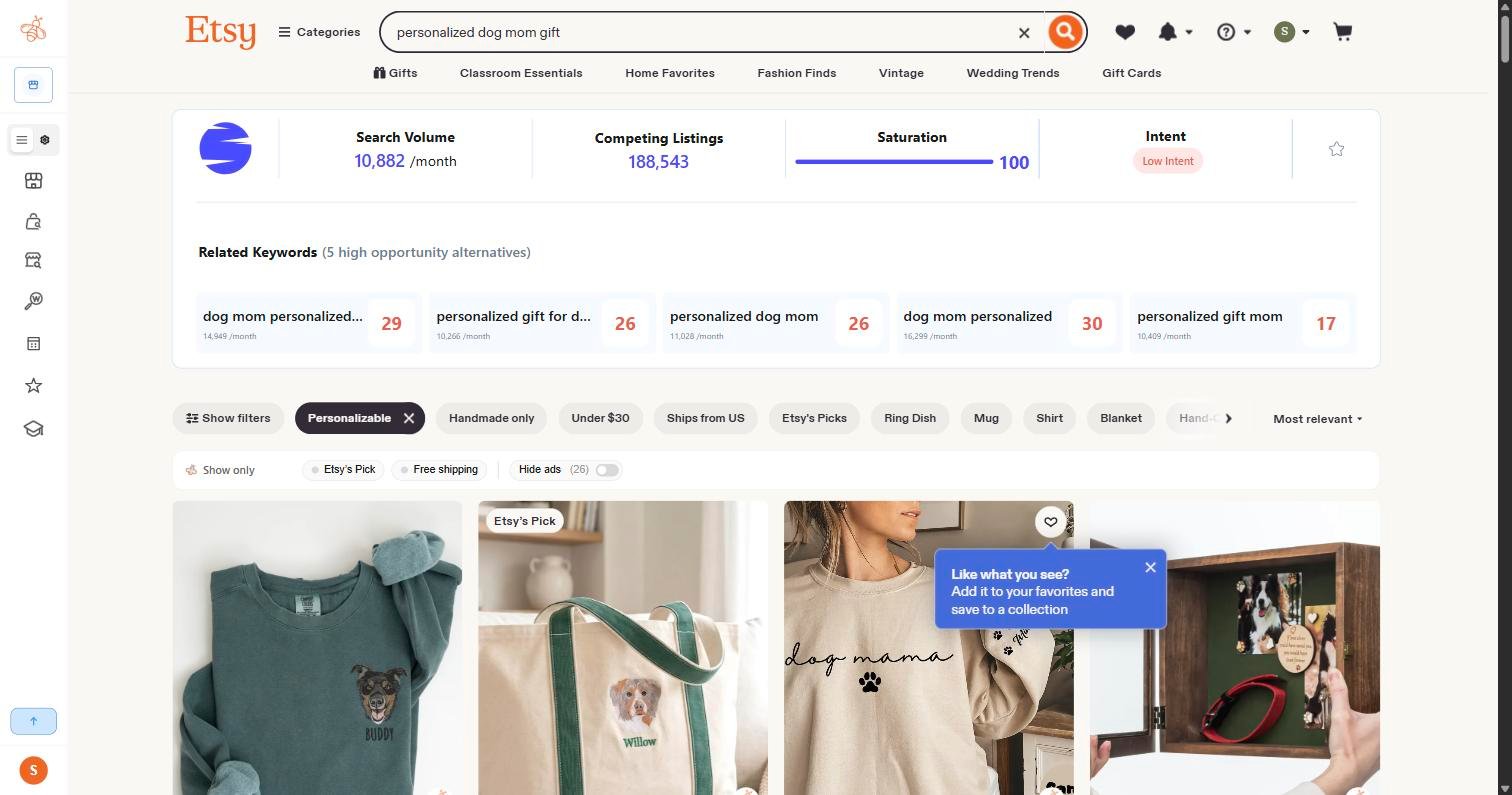
| personalized dog mom gift | 10,882 | 188,543 | 100 | Low |
| funny nurse t-shirt | 12,117 | 53,974 | 100 | Low |
| boho wall art printable | 13,765 | 199,951 | 100 | Mixed |
| teacher appreciation gift | 16,549 | 504,536 | 100 | Low |
| digital planner goodnotes | 16,887 | 119,900 | 100 | Mixed |
| custom pet portrait | 18,354 | 258,705 | 100 | Low |
| custom name necklace | 18,799 | 149,553 | 100 | Mixed |
| dad joke mug | 30,875 | 9,345 | 24 | Low |
| gothic home decor | 32,922 | 693,631 | 100 | Low |
Every keyword landed in the same band
Sort that table by volume and the problem is impossible to miss. The lowest number is 10,398. The highest is 32,922. Everything we tested fits inside a 3.2x band, and nothing came back under ten thousand.
Real search demand does not behave like that. It is power-law distributed: a handful of head terms carry enormous volume and a very long tail carries almost none. Our ten keywords were chosen to span that range deliberately, from “custom name necklace,” which is a genuine head term with 149,553 listings competing for it, down to “dad joke mug,” a novelty phrase with 9,345. A working volume model should put those orders of magnitude apart. This one puts them 1.6x apart, in the wrong direction.
Because that is the other half of it. The highest search volume Sale Samurai returned across all ten keywords was “dad joke mug” at 30,875 a month. Higher than “custom name necklace.” Higher than “custom pet portrait.” Higher than “teacher appreciation gift,” a term with half a million listings behind it.
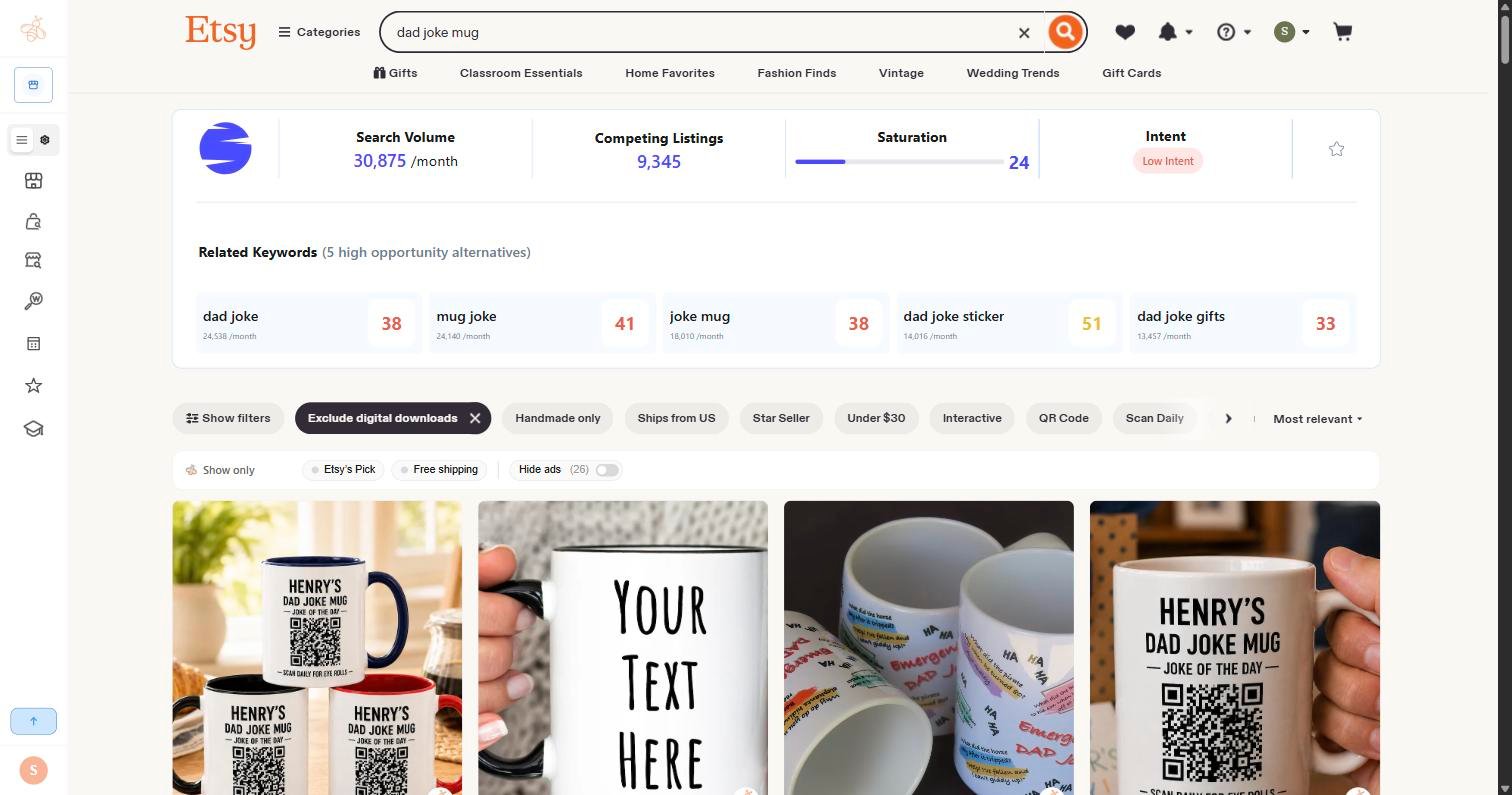
That screenshot contains a second problem worth pausing on. In the related keywords row, the two-word phrase “dad joke” reports 24,538 searches a month while the three-word “dad joke mug” reports 30,875. A longer, more specific phrase pulling more monthly searches than the shorter phrase inside it is the kind of result that should make a model’s own authors nervous. “joke mug” sits at 18,010, below both.
Two of the four headline metrics barely move either. Saturation returned 100, its maximum, on nine of our ten keywords. The only exception was “dad joke mug” at 24. A score that returns its ceiling 90% of the time cannot rank anything, which is the entire job of a score. Intent came back “Low” seven times and “Mixed” three times, and never once “High,” so we have no idea what a good result on that field even looks like.
Word order breaks it
The related-keyword panel is where the model shows its working, and what it shows is that it is keyed on the bag of words rather than the query.
We searched “custom name necklace” and got 18,799 a month. The panel then offered three reorderings of those exact same three words, at three different volumes, one of which was identical to the seed:
| Phrase | Sale Samurai volume | vs seed |
|---|---|---|
| custom name necklace (our search) | 18,799 | seed |
| name custom necklace | 18,799 | identical |
| custom necklace name | 18,769 | 0.998x |
| necklace custom name | 13,737 | 0.73x |
| name necklace custom | 11,030 | 0.59x |
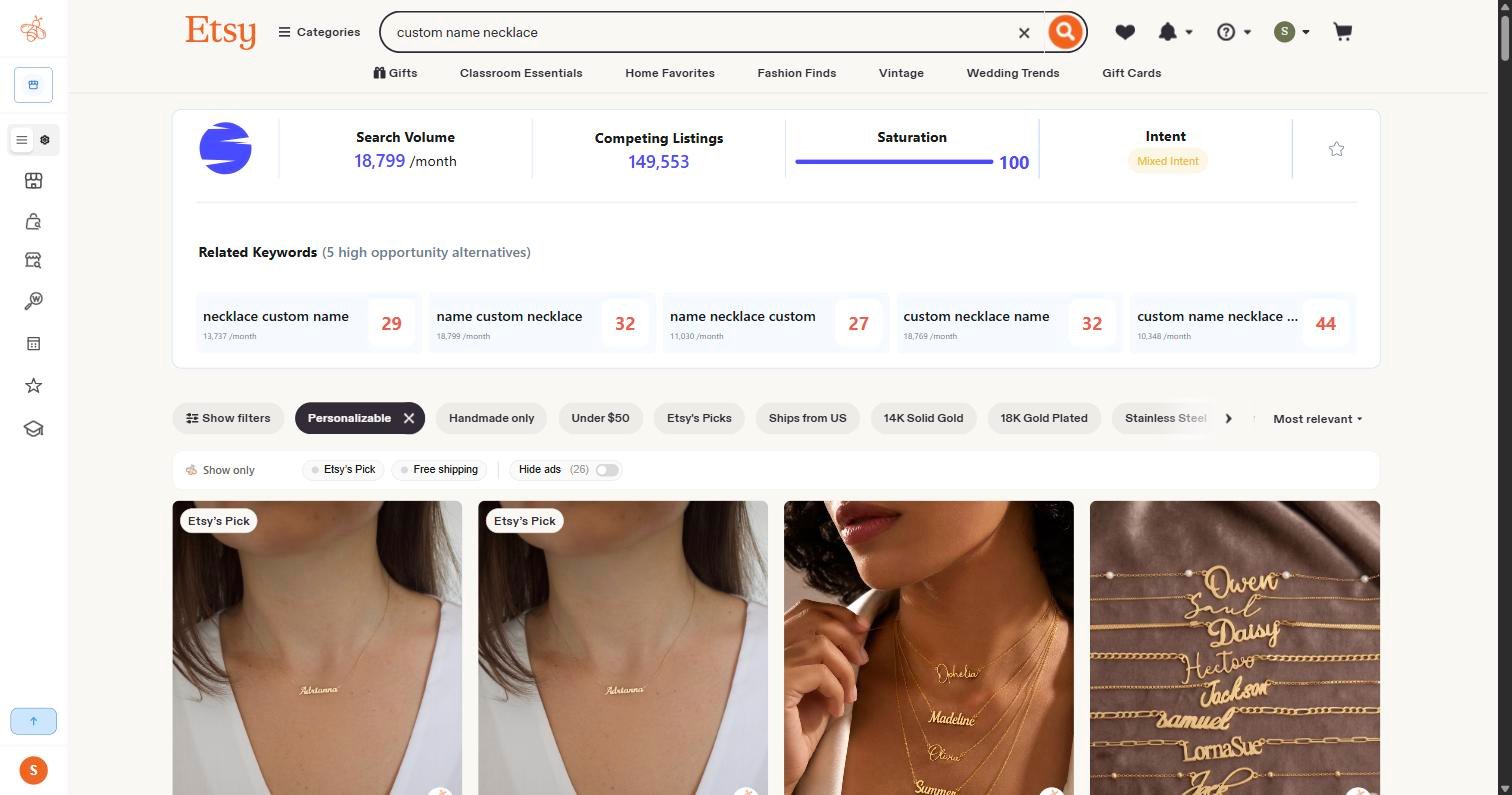
Pick either explanation and the tool has a problem. If word order does not matter, the identical 18,799 makes sense but the other three should match too, and they do not. If word order does matter, the four different numbers make sense but the identical one should not exist. It is doing both at once.
The pattern repeated on other seeds, and not gently:
| Seed | Volume | Reordering | Volume | Ratio |
|---|---|---|---|---|
| crochet pattern pdf | 10,398 | pdf crochet pattern | 33,624 | 3.2x |
| digital planner goodnotes | 16,887 | goodnotes digital planner | 34,787 | 2.1x |
| funny nurse t-shirt | 12,117 | nurse t shirt funny | 21,808 | 1.8x |
“pdf crochet pattern” is not a phrase a human types, and it reports triple the demand of the phrase humans actually type. If you were using this panel to pick which variant to put in your title, it would send you the wrong way.
In fairness, this is not unique to Sale Samurai. We found the same permutation cloning in EverBee’s related keywords and in Alura’s. It appears to be endemic to how these panels are generated. Sale Samurai’s version is the most self-contradictory we have seen.
The one metric that does hold up
It would be unfair to leave this at “the numbers are wrong,” because one of them is right, and which one is revealing.
Put Sale Samurai’s competing-listing counts next to eRank’s for the same keywords:
| Keyword | eRank competition | Sale Samurai competition | Ratio |
|---|---|---|---|
| dad joke mug | 6,309 | 9,345 | 1.48x |
| custom name necklace | 87,377 | 149,553 | 1.71x |
| digital planner goodnotes | 111,644 | 119,900 | 1.07x |
| personalized dog mom gift | 127,999 | 188,543 | 1.47x |
| custom pet portrait | 169,496 | 258,705 | 1.53x |
| boho wall art printable | 185,048 | 199,951 | 1.08x |
| crochet pattern pdf | 336,780 | 509,266 | 1.51x |
| teacher appreciation gift | 415,327 | 504,536 | 1.21x |
| gothic home decor | 468,689 | 693,631 | 1.48x |
Every ratio sits between 1.07x and 1.71x, the ordering is identical across both tools, and the spread from smallest to largest keyword is 74x in Sale Samurai and 74x in eRank. Two independent tools, near-perfect agreement. (Our eRank counts were taken on July 16 and 22 and Sale Samurai’s on July 30, so some of that gap is simply listings added in between.)
This is the structural point our testing keeps arriving at. Competing listings is a count. Somebody can go and count it, so every tool gets roughly the same answer. Search volume is each vendor’s private model, so no two tools agree and nobody can check them. On the countable metric Sale Samurai is fine. On the modeled one it produced 30,875 searches a month for a keyword eRank measured at under 20, a disagreement of more than 1,500x on the keyword where eRank was most explicit.
Here is the same keyword through all five tools we have tested:
| Tool | “personalized dog mom gift” monthly searches |
|---|---|
| eRank | < 20 |
| EverBee | 4,200 |
| Sale Samurai | 10,882 |
| Alura | 481,900 |
| EHunt | No exact-match number at all |
The roundup asked an open question when we had not tested this tool yet: are Sale Samurai’s numbers like eRank’s conservative ones or Alura’s inflated ones? The answer is neither. It sits in the middle on absolute size and has its own distinct failure, which is compression. Alura’s numbers are enormous but they at least vary between keywords. Sale Samurai’s are moderate and nearly flat, and flat is worse, because the entire point of a search volume is to tell one keyword from another.
Where Sale Samurai falls short
- The volume model does not discriminate. Ten keywords, one 3.2x band, no floor below 10,000. It cannot tell you which of two keywords is bigger, which is what you bought it for.
- Saturation is pinned at its maximum. 100 on nine of ten keywords. There is no information in a field that never changes.
- Intent never returned “High.” Seven Low, three Mixed. Same problem, smaller field.
- Related keywords contradict themselves. One reordering identical to the seed, another 3.2x away, in the same panel.
- The web app silently paywalls Freemium users. Clicking a gated tool routes you to the subscription page with no message. That is a dark pattern, not an oversight.
- No methodology disclosure anywhere. Nothing in the extension or the site explains where “real search volume” comes from, which would be an easy way to answer everything above.
- 20 free searches a month is the stingiest free tier we have tested, against eRank’s 5 a day and EHunt’s 5 keyword plus 5 product searches a day.
What genuinely works: the extension is quick and unobtrusive, the credit counter is accurate, the competing-listing counts are trustworthy, and the free tier really does take no card.
Scores
- Ease of use6.5/10
- Free tier value6/10
- Keyword research5/10
- Value for money5/10
- Product research4/10
- Data believability3.5/10
What works
- Free tier needs no payment method at all, confirmed in the account itself
- Chrome extension is fast and sits cleanly on top of Etsy search
- Competing-listing counts match eRank’s within 1.07x to 1.71x, ordering identical
- Credit accounting is exact: 10 searches spent 10 credits, no surprises
- Annual plan genuinely saves two months at $199.90/yr
What doesn’t
- All ten keyword volumes fell in a 3.2x band with nothing under 10,000/month
- A novelty phrase returned the highest volume of anything we tested
- Saturation returned its maximum value on nine of ten keywords
- Reordered phrases returned volumes that were both identical and 3.2x apart
- Every web app research tool is blocked on Freemium with no message
- No methodology note anywhere for a product sold on data accuracy
Sale Samurai vs the alternatives
Sale Samurai vs eRank: not close on the thing that matters. eRank scored 8.5, costs $5.99/mo against $19.99, and its volumes span from “under 20” to 5,298 across our ten keywords, which is what a working model looks like. eRank also shows you which countries a keyword’s searchers are in, which is the single most useful panel in the category. If you are choosing one keyword tool, choose that one.
Sale Samurai vs Alura: both have search volume problems and they are opposite problems. Alura scored 8.2 because its numbers are inflated but it hands you free revenue and sales estimates nobody else does, and its related-keyword breadth is real. Sale Samurai’s numbers are more moderate and less useful, because they barely vary.
Sale Samurai vs EverBee: EverBee scored 8.3 and is the better in-Etsy browsing experience by some distance, though its revenue estimates now cost $29.99/mo. If you want an extension that overlays data while you browse, EverBee does that job better and shows the same permutation quirk in its related keywords.
Sale Samurai vs EHunt: the two weakest tools we have tested, failing differently. EHunt scored 6.5 and cannot return an exact-match number for the keyword you searched at all. Sale Samurai returns one, precise to the digit, that we do not believe. EHunt’s free tier is far more generous.
Where Sale Samurai sits overall: last of six at 5.0 in our comparison, and the only tool where our score went down after hands-on testing.
FAQ
Is Sale Samurai free?
Yes, there is a permanent Freemium plan and it requires no payment method. It gives you 20 keyword searches and 10 listing analyses a month, plus 10 saved keywords and 10 saved listings. The important limit is not published clearly: those keyword searches only work through the Chrome extension while you browse Etsy. Every research tool in the web app is blocked on Freemium. There is also a separate 3-day full-access trial that does not require a card.
How much does Sale Samurai cost?
$19.99/mo billed monthly, or $199.90/year which works out to $16.65/mo. The annual plan is marketed as two months free and the arithmetic checks out against $239.88 paid monthly. Verified on salesamurai.io July 30, 2026.
Is Sale Samurai’s search volume accurate?
We could not make it behave like real demand. Across ten keywords with very different real-world popularity, every volume landed between 10,398 and 32,922 a month, a 3.2x band, and the highest figure of all went to “dad joke mug.” In the same panel, the shorter phrase “dad joke” reported fewer searches than the longer phrase containing it. Its competing-listing counts, by contrast, matched eRank’s closely. Treat the listing counts as reliable and the volumes as directional at best.
Why does Sale Samurai show different numbers than eRank?
Because neither tool can measure Etsy searches directly and each one models them privately. On “personalized dog mom gift” we got under 20 from eRank and 10,882 from Sale Samurai on the same keyword. On “dad joke mug” the gap was under 20 against 30,875. Their competing-listing counts agreed within about 1.5x on every keyword, because that is a count rather than a model. Where two tools disagree by three orders of magnitude, at most one of them is right.
Does the Sale Samurai free plan include the web app?
No, and this is the part worth knowing before you sign up. Clicking Search, Shops or Calculator in the web app on a Freemium account highlights the nav item and then loads the subscription page instead, with no message explaining why. Typing the URL directly does the same thing. Your free credits are usable only in the Chrome extension.
Is Sale Samurai worth $19.99 a month?
Not on the evidence we gathered. You are paying primarily for search volume data, and that is the part that did not hold up across ten keywords. eRank’s Pro plan is half the price with volumes that actually discriminate between keywords, and its Basic plan is $5.99. If you specifically want the in-Etsy extension experience, EverBee’s is better built, and Sale Samurai’s own free tier lets you judge the data yourself for nothing before you commit.
Did you test the paid version?
No. We test on free tiers with fresh accounts and we do not pay for tools, so the paid web app is unscored here. Everything above comes from the Freemium plan and the Chrome extension on July 30, 2026, and the review says so wherever it matters.
See Sale Samurai →Freemium $0 · No card required · Paid from $16.65/mo billed annually
Keep reading
We Asked Five Etsy Keyword Tools the Same Question. They Disagreed by 24,000x
Same keywords, five tools, then the same test three months later. Listing counts agree. Search volumes don’t, and two tools hadn’t changed a single one since July.
eRank Review (2026): We Tested 10 Keywords Over Two Days
Our top pick, and it won by being the only tool honest enough to say a keyword had almost no demand. Its country panel also shows which searches come from other sellers rather than buyers.