We may earn a commission when you buy through links on this page, at no extra cost to you. Tools can’t pay for placement or scores. How we make money · How we test
eRank won our six-tool comparison, and it did not win by having the prettiest interface or the biggest numbers. It won because it was the only tool that told us when a keyword was worthless. This review goes deeper than the roundup did: ten keywords across two testing days, the full data table, and the one panel in eRank that changed how we read every keyword afterwards. That panel is not the search volume. It is the list of countries the searches came from.
In this review
- Quick verdict
- Is eRank accurate? The short answer
- What the free plan gives you
- Pricing (verified July 30, 2026)
- Our full keyword data, both days
- The country panel: eRank’s best feature
- Why “<20” is a feature, not a failure
- The CTR over 100% thing, explained
- Free top-100 listing analysis
- Where eRank falls short
- Scores
- eRank vs the alternatives
- FAQ
The quick verdict
eRank: the most honest keyword data in the category, for a third of what the competition charges
eRank reports low demand as low demand instead of inventing a number, breaks down the top 100 ranking listings for free on every search, and tells you which countries a keyword’s searches come from, which is the fastest way to spot a keyword that only other sellers are researching. The interface is dated and the free plan is stingy on breadth at 5 lookups a day. Paid starts at $5.99/mo, which is the best value in Etsy research tools right now.
Try eRank Free →Free plan · 5 keyword lookups/day · No card required
In a hurry? If you research keywords and want numbers you can trust, eRank is the pick, and Pro at $9.99/mo costs a third of EverBee’s $29.99 Growth plan. If you specifically want free sales and revenue estimates, Alura is the only tool still giving those away. If you want to browse Etsy with data overlaid on the page, EverBee’s extension does that better.
What the free plan actually gives you
eRank’s free plan has no time limit and needs no card. It is genuinely usable, but it is generous in an unusual direction: deep on each keyword, stingy on how many keywords you get.
| Feature | Free plan |
|---|---|
| Keyword lookups | 5 per day |
| Search Results Analysis (top 100 listings per keyword) | Free, and does not use a lookup |
| Searchers by Country breakdown | Included |
| Connected shop | 1 shop, 50 listings |
| Listing audits | 5 per day |
| AI Listing Helper | 1 use per day |
| Related keyword ideas | Paywalled (names teased, data blurred) |
The 5-per-day cap is real and strictly enforced. A counter sits in the top bar showing how many you have left, and when it hits zero you are done until tomorrow. That is why our test ran over two days rather than one.
The genuinely valuable free feature is the one nobody advertises: the Search Results Analysis does not consume a lookup. More on what it contains below.
Pricing: verified on erank.com, July 30, 2026
| Plan | Monthly | Annual (per month) | Keyword lookups/day | Competitors monitored |
|---|---|---|---|---|
| Free | $0 | $0 | 5 | None |
| Basic | $5.99 | $5.50 ($65.99/yr) | 100 | 5 |
| Pro | $9.99 | $7.92 ($94.99/yr) | 200 | 50 |
| Expert | $29.99 | $22.50 ($269.99/yr) | 500 | 200 |
Every paid tier carries a 14-day money-back guarantee, which is worth noting because it is the opposite of the annual auto-renew complaints that dog some competitors. Annual billing saves $6/yr on Basic, $25/yr on Pro and $90/yr on Expert.
Here is the comparison that matters. eRank Pro is $9.99/mo and gives you 200 keyword lookups a day. EverBee’s Growth plan, the tier that unlocks its revenue estimates, is $29.99/mo. EHunt’s entry tier is now $9.99/mo and cannot return exact-match data for the keyword you searched. On price against capability, eRank is not close to its rivals. It is well ahead.
Is eRank accurate? The short answer
eRank is the most trustworthy of the five Etsy keyword tools we tested, but its search volumes are still estimates. Etsy does not publish search counts, so every tool models them. What sets eRank apart is honesty at the low end: on 4 of our 10 keywords it reported “< 20” searches instead of inventing a number. For “personalized dog mom gift,” on the same day, eRank said under 20, EverBee said 4,200 and Alura said 481,900.
- Competing listings: trust it. It is a real count, and eRank, EverBee and Alura agreed within 1.68x on it in our same-day test.
- Search volume: use it to find your strongest keyword, not to rank the weak ones. The tools broadly agreed on the strongest keyword in our test and contradicted each other below it. Our five-tool accuracy study has every number.
Our full keyword data, both testing days
Ten seed keywords, five per day, on a free account. These are the raw numbers off our screen, not a summary.
Day 1, July 16, 2026:
| Keyword | Avg searches | Avg clicks | CTR | Etsy competition | KD | Google searches |
|---|---|---|---|---|---|---|
| personalized dog mom gift | < 20 | Unknown | Unknown | 127,999 | 100 | 320 |
| funny nurse tshirt | < 20 | Unknown | Unknown | Unknown | Not shown | N/A |
| boho wall art printable | < 20 | < 20 | < 20% | 185,048 | 100 | 70 |
| custom name necklace | 2,523 | 2,762 | 109% | 87,377 | 77 | 18,100 |
| digital planner goodnotes | 1,137 | 1,134 | 100% | 111,644 | 100 | 90 |
Day 2, July 22, 2026:
| Keyword | Avg searches | Avg clicks | CTR | Etsy competition | Notes |
|---|---|---|---|---|---|
| custom pet portrait | 5,298 | 6,067 | 115% | 169,496 | “Trending in Search!” badge |
| teacher appreciation gift | 2,668 | 2,522 | 95% | 415,327 | Trending badge, big July spike |
| dad joke mug | < 20 | Unknown | Unknown | 6,309 | Lowest competition we found |
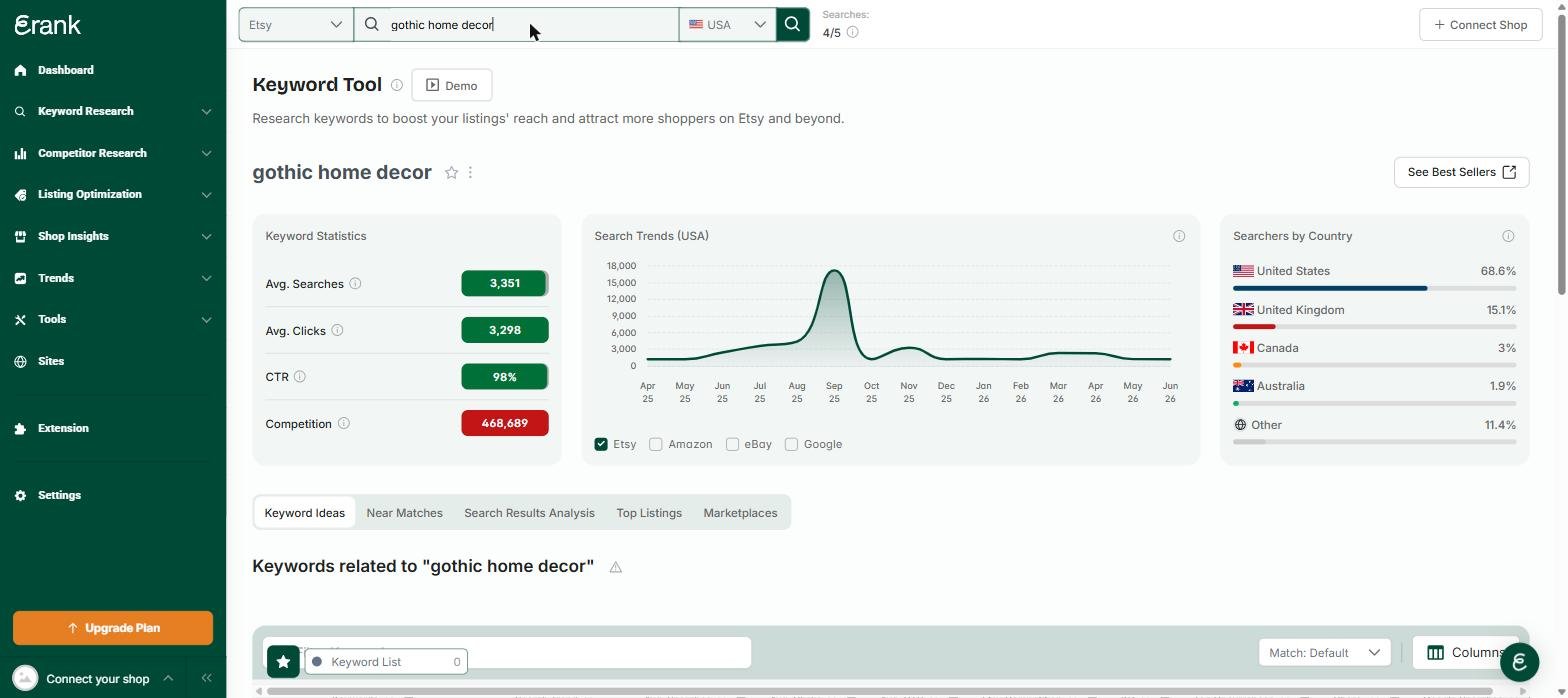
| gothic home decor | 3,351 | 3,298 | 98% | 468,689 | Clean Sept/Halloween seasonal curve |
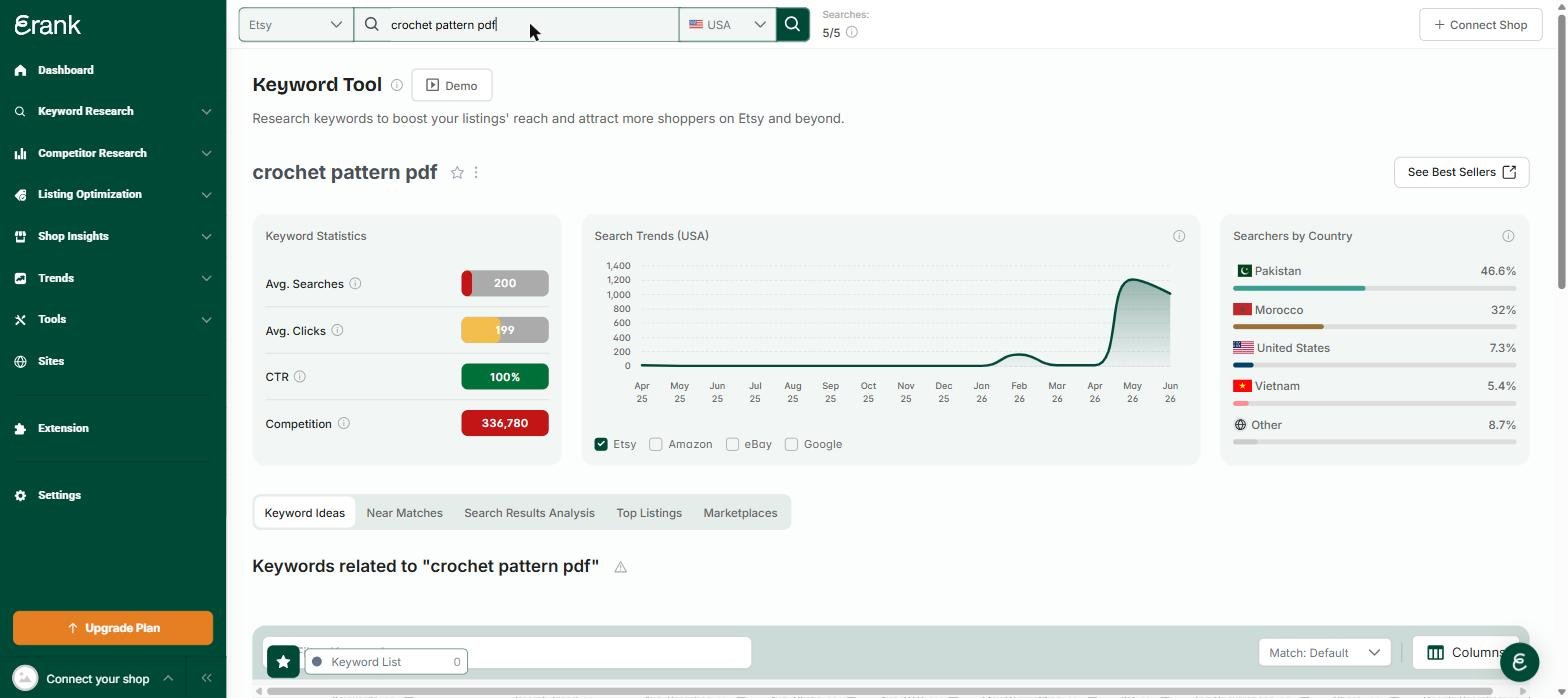
| crochet pattern pdf | 200 | 199 | 100% | 336,780 | May to June 2026 spike |
The country panel is eRank’s best feature, and almost nobody mentions it
Every tool gives you a search volume. Only eRank tells you where the searches came from, and once you start reading that panel you cannot unsee it.
Here is why it matters. Etsy keyword tools cannot distinguish a buyer typing “personalized dog mom gift” from a print-on-demand seller in another country researching what to list. Both are searches. Both inflate the volume. The country breakdown is the closest thing to a signal that separates them, because genuine buyer demand for US-market giftware concentrates in the US, UK, Canada and Australia. When a keyword’s searchers are majority Vietnam, Pakistan or Morocco, you are almost certainly looking at other sellers doing exactly what you are doing.
Across our ten keywords, this pattern showed up again and again:
| Keyword | Top searcher countries | Read |
|---|---|---|
| crochet pattern pdf | Pakistan 46.6%, Morocco 32%, US 7.3% | Roughly 79% seller research |
| personalized dog mom gift | Vietnam 38.5%, US 23.1% | Seller-dominated |
| teacher appreciation gift | Vietnam 34.7% | Seller-dominated |
| dad joke mug | Canada 38.5%, Vietnam 38.5%, US 23.1% | Mixed |
| custom pet portrait | US 31.9%, Turkey 11%, Pakistan 10.6%, UK 9.2% | Mixed, US-leading |
| gothic home decor | US 68.6%, UK 15.1% | Real buyer demand |
Now look at the counter-example. “gothic home decor” has the highest competition of anything we tested at 468,689 listings, which on any other tool reads as a keyword to avoid. But 68.6% of its searchers are in the US and 15.1% in the UK, and its trend line shows a clean, predictable ramp into September and Halloween. High competition with real buyers behind it is a different proposition than low competition with none.
This single panel is the strongest argument for eRank over anything else in the category. No other tool we tested shows it.
Why “<20” is a feature, not a failure
Four of our ten keywords came back as “< 20” average searches. On first read that looks like eRank failing to return data. It is the opposite, and it is the single reason eRank won our comparison.
We asked four tools the same question on the same day: how many people search Etsy for “personalized dog mom gift” each month?
| Tool | Monthly searches | Competition |
|---|---|---|
| eRank | < 20 | 127,999 |
| EverBee | 4,200 | 152,000 |
| Alura | 481,900 | 182,200 |
| EHunt | No exact-match number at all | N/A |
That is a 24,000x spread on “search volume” between the tools, while their competition counts all land within about 40% of each other. The reason is structural: competition is a listing count, which is countable, so tools agree on it. Search volume is each vendor’s private model, so they do not.
Faced with a keyword that has almost no measurable demand, three tools produced a confident number anyway. eRank said it did not have one. When you are deciding what to spend weeks making, a tool that admits uncertainty is worth more than one that manufactures precision. We go deeper on this in EverBee vs eRank.
The CTR over 100% thing, explained
This confused us on day 1 and it recurred on day 2, so it is worth explaining rather than treating as a bug. “custom name necklace” showed 2,523 average searches against 2,762 average clicks, a CTR of 109%. “custom pet portrait” showed 115%.
It is not an error. One search session can produce several listing clicks: a shopper searches once, then opens four listings in tabs to compare them. Clicks can legitimately exceed searches. Read a CTR above 100% as a browsing-heavy, comparison-shopping keyword, which is generally a good sign for a considered purchase like custom jewellery or a commissioned pet portrait. eRank does not explain this anywhere in the interface, which is a documentation gap rather than a data problem.
The free feature that beats every paid competitor: top-100 listing analysis
This is the part of eRank we would pay for on its own, and it is free, and it does not consume one of your five daily lookups.
Run a Search Results Analysis on any keyword and eRank breaks down the top 100 ranking listings for it. For “personalized dog mom gift” our account returned:
- Average price $25.49 and median price $12, a gap that immediately tells you the category is split between cheap digital files and higher-priced physical goods
- Total views across the top 100 listings: 230,700
- A tag word-cloud showing what actually ranking listings are tagged with
- Category percentages, hearts, and listing processing times
That median-versus-average price gap is the kind of thing that changes what you decide to make, and no other free tool in our test surfaced it. If you use eRank for nothing else, use it for this.
Where eRank falls short
It is our top pick, not a perfect tool. Four honest complaints:
- The free plan is stingy on breadth. Five lookups a day is workable for a hobbyist and painful for anyone doing real research. Testing ten keywords took us two calendar days.
- Related keyword ideas are fully paywalled on free. You can see that suggestions exist, with the names teased and the data blurred out. This is the exact opposite trade-off to EverBee, which hands you hundreds of related keywords free but of dubious quality. eRank gives you depth without discovery, EverBee gives you discovery without depth.
- The interface is dated and slower than its rivals. It works, and the daily counter is admirably clear, but next to EverBee it feels a decade older.
- Small rough edges. Keyword input silently auto-normalizes, so “funny nurse t-shirt” became “funny nurse tshirt” without telling us. The CTR-over-100% figure goes unexplained. Neither is serious, both would confuse a beginner.
Scores
- Value for money9.5/10
- Data believability9.5/10
- Keyword research9/10
- Free tier value8/10
- Ease of use7.5/10
- Product research7.5/10
What works
- Reports low demand honestly as “<20” instead of inventing a number
- Searchers by Country panel exposes seller-research traffic no other tool reveals
- Free top-100 listing analysis, and it does not use a daily lookup
- Cheapest paid tier in the category at $5.99/mo, with a 14-day money-back guarantee
- Shows Google search volume alongside Etsy, useful for off-platform demand
- Daily lookup counter is always visible, so you never burn budget by accident
What doesn’t
- Only 5 keyword lookups per day on free, which forces multi-day research
- Related keyword ideas completely paywalled on the free plan
- Dated interface, noticeably slower than EverBee
- CTR above 100% appears regularly with no explanation in-product
- Silently auto-normalizes your keyword input
- KD and Google Searches columns were not visible in the day-2 layout
eRank vs the alternatives
eRank vs EverBee: the head-to-head everyone asks about, and we ran it properly in EverBee vs eRank. Short version: EverBee has the better interface and the better in-Etsy browsing workflow, eRank has the more trustworthy data and costs a third as much. If you research keywords, eRank. If you browse Etsy and want data on the page, EverBee.
eRank vs Alura: Alura is the only tool still showing sales and revenue estimates on a free plan, which is a real advantage if that is what you need. But Alura returned 481,900 monthly searches for a keyword eRank measured at under 20, which tells you how much weight to put on its volume figures. Use Alura for revenue estimates, eRank for keyword decisions.
eRank vs EHunt: not really a contest. EHunt scored 6.5, its entry tier is now $9.99/mo against eRank’s $5.99, and it cannot return exact-match data for a keyword you search. EHunt is a brainstorming layer, not a research tool.
Where eRank sits overall: first place at 8.5 in our six-tool comparison, and it is the tool we would put in a new seller’s hands.
FAQ
Is eRank free?
Yes, permanently, with no card required and no time limit. The free plan gives you 5 keyword lookups per day, 1 connected shop with 50 listings, 5 listing audits per day, 1 AI Listing Helper use per day, the Searchers by Country panel, and the full top-100 Search Results Analysis, which does not count against your daily lookups. Related keyword ideas are the main thing held back.
How much does eRank cost?
Basic is $5.99/mo or $5.50/mo billed annually ($65.99/year). Pro is $9.99/mo or $7.92/mo annually ($94.99/year). Expert is $29.99/mo or $22.50/mo annually ($269.99/year). All paid plans carry a 14-day money-back guarantee. Verified on erank.com July 30, 2026.
Is eRank accurate?
More trustworthy than its rivals, with an important caveat. Its competition counts are listing counts, which are countable and match other tools closely. Its search volumes are still a model, like everyone else’s. What sets eRank apart is that it reports “<20” when demand is too low to measure rather than generating a confident number, which is what the other three tools did on the same keyword on the same day. Use its volumes to pick your strongest keyword rather than to rank weaker ones against each other, and do not quote them as fact.
Why does eRank show fewer searches than EverBee or Alura?
Because it is not inflating them. On “personalized dog mom gift” we got <20 from eRank, 4,200 from EverBee and 481,900 from Alura on the same day. None of these tools can measure Etsy searches directly, so each one models it differently. eRank’s model is the conservative one, and its willingness to return “not enough data” is a deliberate design choice rather than a limitation.
What does a CTR over 100% mean in eRank?
It means clicks exceeded searches, which happens when one shopper opens several listings from a single search to compare them. It is not a bug. Treat it as a signal that the keyword drives comparison shopping, which is common on considered purchases like custom jewellery. We saw 109% on “custom name necklace” and 115% on “custom pet portrait.”
Is eRank worth paying for?
If you research keywords more than a few times a week, yes. The free plan’s 5 lookups per day is the real constraint, and Basic at $5.99/mo lifts that to 100. That is the cheapest meaningful upgrade in the category, and the 14-day money-back guarantee means trying it costs nothing if it does not fit.
What is the Searchers by Country panel and why does it matter?
It shows the geographic breakdown of who searched a keyword. It matters because Etsy keyword tools cannot tell buyers apart from sellers doing research, and both inflate volume. When a US-market giftware keyword shows most of its searchers in Vietnam, Pakistan or Morocco, the demand is largely other sellers. In our test “crochet pattern pdf” was roughly 79% Pakistan and Morocco, while “gothic home decor” was 68.6% US. Same tool, completely different quality of demand.
Try eRank Free →Free plan · 5 keyword lookups/day · Paid from $5.99/mo · 14-day money-back guarantee
Keep reading
We Asked Five Etsy Keyword Tools the Same Question. They Disagreed by 24,000x
Same keywords, five tools, then the same test three months later. Listing counts agree. Search volumes don’t, and two tools hadn’t changed a single one since July.
EverBee vs eRank: We Ran Both on the Same Keywords
The two names every Etsy seller hears first. And the answer changed in 2026, because EverBee’s famous free feature quietly moved behind a paywall.